Lesssons Learned is a series in which I ask questions that can help me become a better writer. I try to learn from all the stories I encounter – the good, the bad and the ugly.
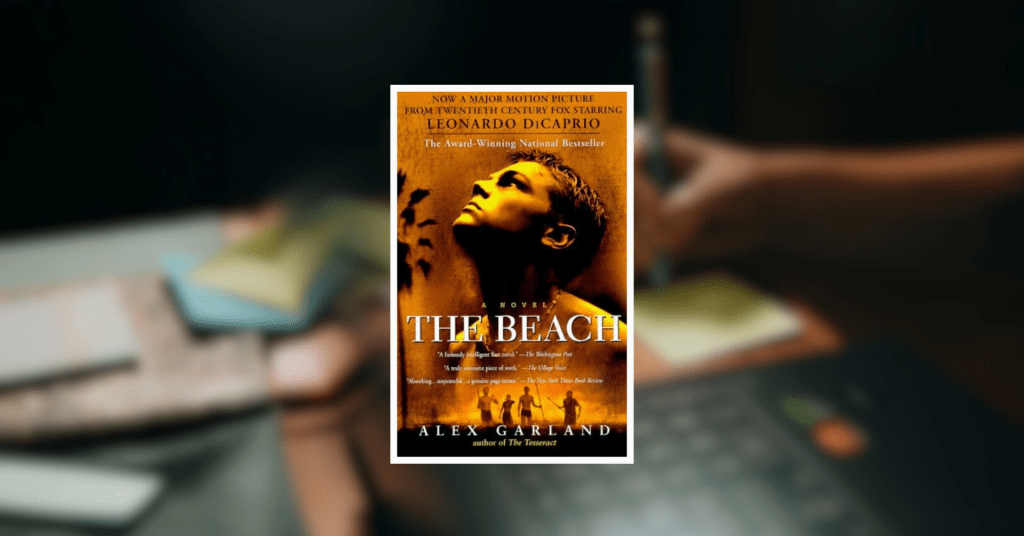
Today’s focus is Alex Garland’s 1996 novel The Beach, which was adapted into a major Hollywood film directed by Danny Boyle and starring Leonardo DiCaprio.
The story unfolds within a secluded community of backpackers who have discovered a hidden paradise. It’s praised for its social commentary on tourism and Western idealism.
Publisher’s blurb
The Khao San Road, Bangkok – first stop on the backpacker trail. On Richard’s first night there a fellow traveller slits his wrists, leaving Richard a map to “the Beach”.
The Beach is a legend among young travellers in Asia: white as sands circling a lagoon hidden from the sea, coral gardens and freshwater falls surrounded by jungle. In this earthly paradise, it is rumoured, a select community lives in blissful innocence. For Richard, haunted by the glamour of Vietnam war movies, a trek into unknown Thai territory is irresistible. He was looking for adventure. Now he’s found it.
If you haven’t read the book or seen the movie, don’t worry—this is all you need to know to follow along.
1. Do My Supporting Characters Have Agency?
On one of the lazier days depicted in The Beach, the characters are asked to state their favorite countries in the world. Each answer offers the reader deeper insight into their personalities. However, Indonesia—Françoise’s favorite—is described only as “beautiful.”
This trend continues throughout the book: Françoise doesn’t seem like a fully fleshed-out character with her own agency but rather an object of desire for the main protagonist.
This often occurs when a writer attempts to create a character with a different gender, sexual orientation, or cultural background than their own.
To ensure that my characters—especially those who are very different from me—are not reduced to superficial qualities, I need to make sure they have their own agency and development.

2. How Do I Create Basic Suspense?
The story of The Beach, as an urban myth, is incredibly alluring. It is whispered about. Some people have heard of it, while others are completely unaware that such a place could exist. What they all share, however, is the hope that this secret paradise is real and that they might gain special access to it.
Am I successful in creating such anticipation in my own writing?
Sometimes, it helps me to think of suspense as a chain of questions. When one question is resolved, another should already be looming for the reader.
These questions don’t need to be explicitly stated but should naturally arise from the reader’s curiosity. For example, in the exposition of The Beach, they might include: Does the secret beach really exist? Is it possible to reach it?
And once these are resolved, new questions should emerge: What is the catch of living there? How does the commune operate? Is this a cult?
3. Am I Sacrificing Depth for Shock Value?
As the novel progresses, the level of violence escalates to such an extent that it strains credibility. When it comes to intense elements like gore, less is often more.
In The Beach, the increasing violence heightens tension and reflects the characters’ descent into chaos. However, as the brutality becomes more graphic, it overshadows the psychological elements that initially captivated readers.
So, at what point does gore undermine the story rather than enhance it?
If I aim to shock my audience, I must integrate it meaningfully into the plot and character development. I can’t simply transition from suspense to shock after shock after shock; doing so will leave the audience emotionally numb.
Does the intensity of negative events support the plot, or am I simply trying to shock the reader? Do my characters react appropriately to these events? For example, if someone dies, do their responses reflect their personalities? Do I give them enough time to grieve?
4. Do I Avoid Clichéd Plotlines?
In the movie, the producers opted to exploit Leonardo DiCaprio’s star power by having Richard sexually involved with both Françoise and Sal. This choice stripped the relationship between Richard and Françoise of its complexity and turned it into a clichéd romance.
Unlike the film, the novel keeps both of these connections nuanced and resolves them in a much deeper fashion. It keeps their interactions intriguing and true to real-life emotional complexities.
If the market is oversaturated with similar plotlines, I should consider how I can introduce a new perspective.
Do I successfully avoid repetition? If a particular storyline or character arc has been done to death, it might be best to avoid it unless I have a truly unique spin on it.
After finishing The Beach, what stuck with you? Feel free to drop me a message or leave a comment below.
 Story Begins
Leave a comment